“Vision without action is a daydream. Action without vision is a nightmare.“
– Japanse proverb
I came up with the idea for Chrono Chronicles after playing around with some alternative means of interaction in Head in the Clouds. I’m a great admirer of the open/closed drafting game mechanic, where each player gets to choose one or more cards from a collection of cards. There are always multiple interesting choices between a card the player chooses, because they increase her success, and the cards she might not choose, knowing it might greatly benefit another player’s progress if left in the game. This increases the dilemma she experiences. In essence, the element of dilemma has the potential to transform decisions into critical junctures, driving engagement through reciprocal dynamic gameplay and fostering strategic adaptability, thereby enriching the overall gaming experience with diverse tactical challenges. This mechanic worked quite well but didn’t solve the problem I ran into at the time, so I parked this concept, to revisit later. Now, I want to take this concept and create a dedicated game for it.
Game Concept
In “Chrono Chronicles,” players are given the power to navigate through the annals of time, from the dawn of civilization to the frontiers of the future. As temporal architects, they shape the course of history by ushering in key events, groundbreaking inventions, and landmark cultural developments.
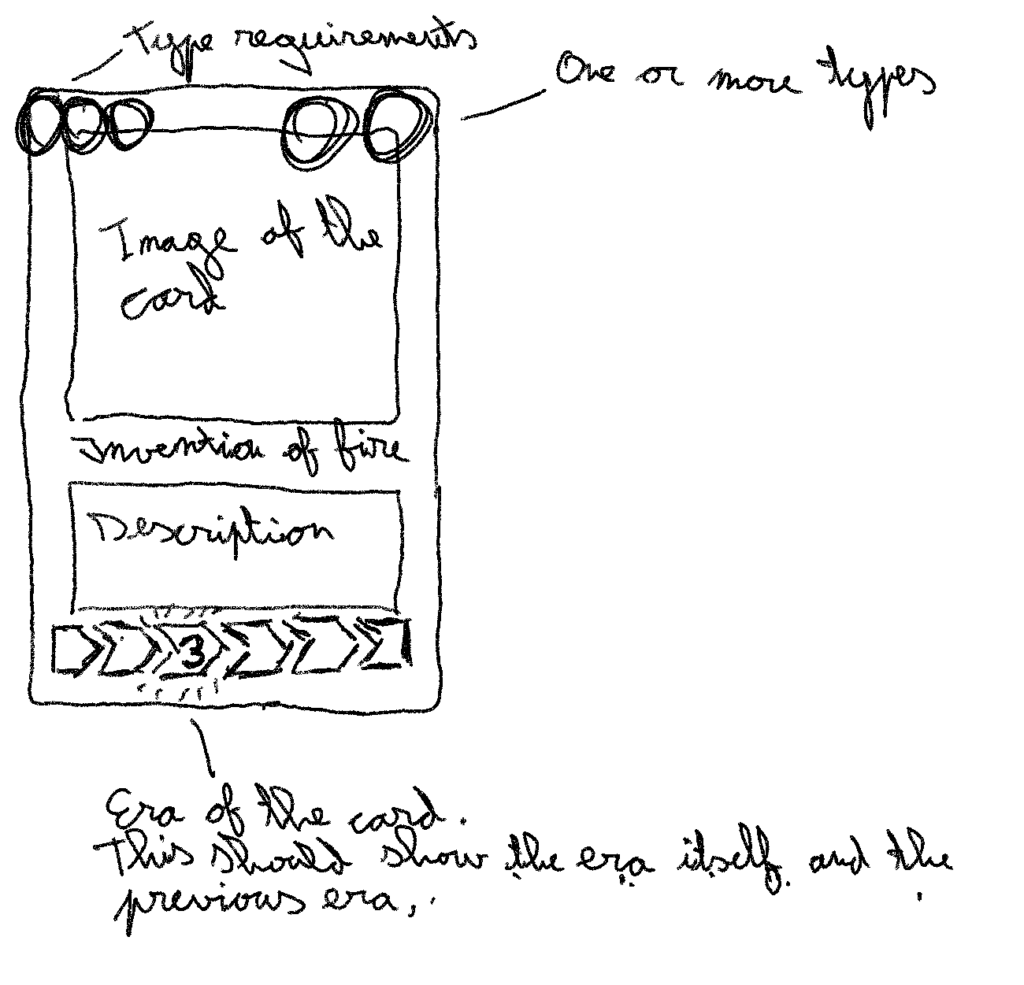
Each player’s tableau represents a unique timeline that they construct from a shared pool of chronicle cards. These cards, divided into various categories like economic, cultural, and scientific, represent significant moments in history. From the invention of fire to the rise of Artificial Intelligence, each card offers unique abilities and opportunities.
Chrono Chronicles centers around the open drafting and grid coverage mechanics. In the center of the table is a grid of 3×3 cards that players take cards from in turn order. After all players have taken a card, the grid is replenished to 9 cards. Ordinarily, the player on the left of the first player will receive the first player token and the next round begins. When a player takes a card, they immediately place it on their own player board. A player board exists of a 4×4 or 5×5 empty grid with bonuses on the side. As soon as a row or column is full, that player receives this bonus (for example, they might take another card, or recieve the first player token next round). Each card also specifies an action. This action is immediately triggered when the player places a card on their player board, but can be triggered again later, when another card is placed adjacent to it from the same era, or an era later. There are six eras in total, which are all placed in a single deck. These eras are:
- Prehistoric Era: This could include cards like ‘Discovery of Fire’, ‘Invention of Wheel’, ‘First Agriculture’, etc. The effects of these cards could be relatively simple, laying the groundwork for future developments.
- Classical Era: This era might contain cards like ‘Birth of Democracy’, ‘Great Wall of China’, ‘Roman Empire’, etc. Cards from this era could start introducing interactions with other players, reflecting the increased societal complexity of this time period.
- Middle Ages: Cards like ‘Crusades’, ‘Feudal System’, ‘Gutenberg’s Printing Press’, etc., could be a part of this era. The effects of these cards could revolve around advancement and expansion, but also potential setbacks or conflicts.
- Industrial Era: With cards like ‘Industrial Revolution’, ‘Invention of Telephone’, ‘Steam Engine’, etc., this era could introduce more complex economic and technological mechanics.
- Modern Era: This era could include cards like ‘World War II’, ‘Internet Invention’, ‘Space Race’, etc. The mechanics of these cards could involve high-stakes rewards and risks, as well as global impacts.
- Future Era: This could have cards like ‘Mars Colonization’, ‘Singularity’, ‘Climate Restoration’, etc. The effects of these cards could be highly variable and powerful, reflecting the uncertainty and potential of the future.
Pillars and design goals
In order to keep the mechanics, dynamics and aesthethics of the game focussed on my design vision, I first set up some design pillars and an overarching design goal. The goal of the game is to design an immersive experience of time travel, where strategic adaptability is key, driven by a unique era-based card placement system. This system should underscore the importance of card selection, chronological progression, and interaction between players, thus presenting a thrilling dilemma in every decision and a dynamic, player-influenced gameplay evolution. The design pillars are:
- Strategic Interaction: This game encourages players to think critically not only about which cards to play but also where to place them, because they later need to align with other cards in order to place them. They should also be incentivized to look at other players’ tableaus.
- Historical Progression: The game’s theme is centered around the passage of time and the development of civilizations. It brings historical events, inventions, discoveries, and figures to life in an interactive, engaging way.
- Adaptive Gameplay: Players need to constantly adapt their strategies based on the actions of others and the cards drawn. This makes each game dynamic and different from the last.
- Balanced Conflict: While the game features aggressive mechanics like war cards that affect other players, it’s important to maintain a balance where every player has a chance to recover or respond. This pillar emphasizes that no player should feel hopeless or excessively targeted during the game.
Card types & cost
There are five different Pillars of Civilization (PoC), Knowledge, Power, Wealth, Culture, and Science. These are produced by cards in play and act as prerequisites to play other cards. They can, however, only be met by adjacent cards. This further increases the dilemma of which cards to play. Will a player consume the available PoC right now for a guarenteed smaller gain, or will she wait for a larger, albeit less certain gain in a future turn?
Cards in Chrono Chronicles not only interact and activate based on their placement and PoC, but they also yield Welfare, symbolizing the overall prosperity of a player’s civilization. For instance, a card might generate 2 Welfare points. These Welfare points accumulate over time as you add more cards to your tableau. For instance, if a player has three cards generating 1, 1, and 2 Welfare points respectively, the total Welfare produced by their civilization is 4. They can then play cards that are worth 4 welfare points. Note that they do not spend this welfare, so later welfare cards can be quite expensive, because welfare is never lost, except for cards that have a negative impact on the civilization, like certain warware cards.
This Welfare system is not only an economic mechanism for acquiring new cards (since the accumulated Welfare can be “spent” on obtaining more powerful or era-advancing cards), but it also directly ties into the victory condition of the game. The ultimate goal of the player is to amass the highest level of Welfare by the end of the game, representing the culmination of their civilization’s growth and progress throughout different eras. Hence, strategic decision-making to maximize Welfare yield becomes an integral part of gameplay.
To make sure that there are different strategies to try out, tying into the pillars of Adaptive Gameplay and Balanced Conflict, there are card types of four different categories of cards:
- Warfare: This can introduce a direct player interaction aspect to your game, providing a way to disrupt opponents’ strategies or defend against their attacks. This faction could contain cards that enable players to remove or block opponents’ cards, swap positions of cards in their tableau, or potentially even ‘steal’ cards.
- Economy: This faction is geared towards the accumulation of wealth and prosperity. Economy cards could help players gain additional welfare or discount on future card purchases, or perhaps even provide a way to earn victory points directly. This can be a slower, steady approach to gaining power.
- Science: The science faction could offer benefits to players who focus on innovation and progress. These cards could enable players to upgrade other cards, add additional abilities to them, or gain bonus points for certain types of sets or configurations of cards in their tableau.
- Culture: This faction might include ways for players to manipulate their own tableau, such as by repositioning cards, duplicating effects, or gaining benefits from the variety of cards in their tableau. These cards might be more about personal growth and internal improvements rather than outward expansion.
Trojan Horse card: play a card in someone else’s tableau which works in your benefit.
Leave a Reply